Why Is RBI Keeping Tata Sons Under Tighter Regulation? The Business Behind a Possible Tata Sons IPO
Business

Why Is RBI Keeping Tata Sons Under Tighter Regulation? The Business Behind a Possible Tata Sons IPO

Published on 8/8/2026

Summary

The RBI's latest decision has revived a question that could reshape one of India's most closely held business groups: does Tata Sons, the holding company at the centre of the Tata empire, eventually have to become a publicly listed company?

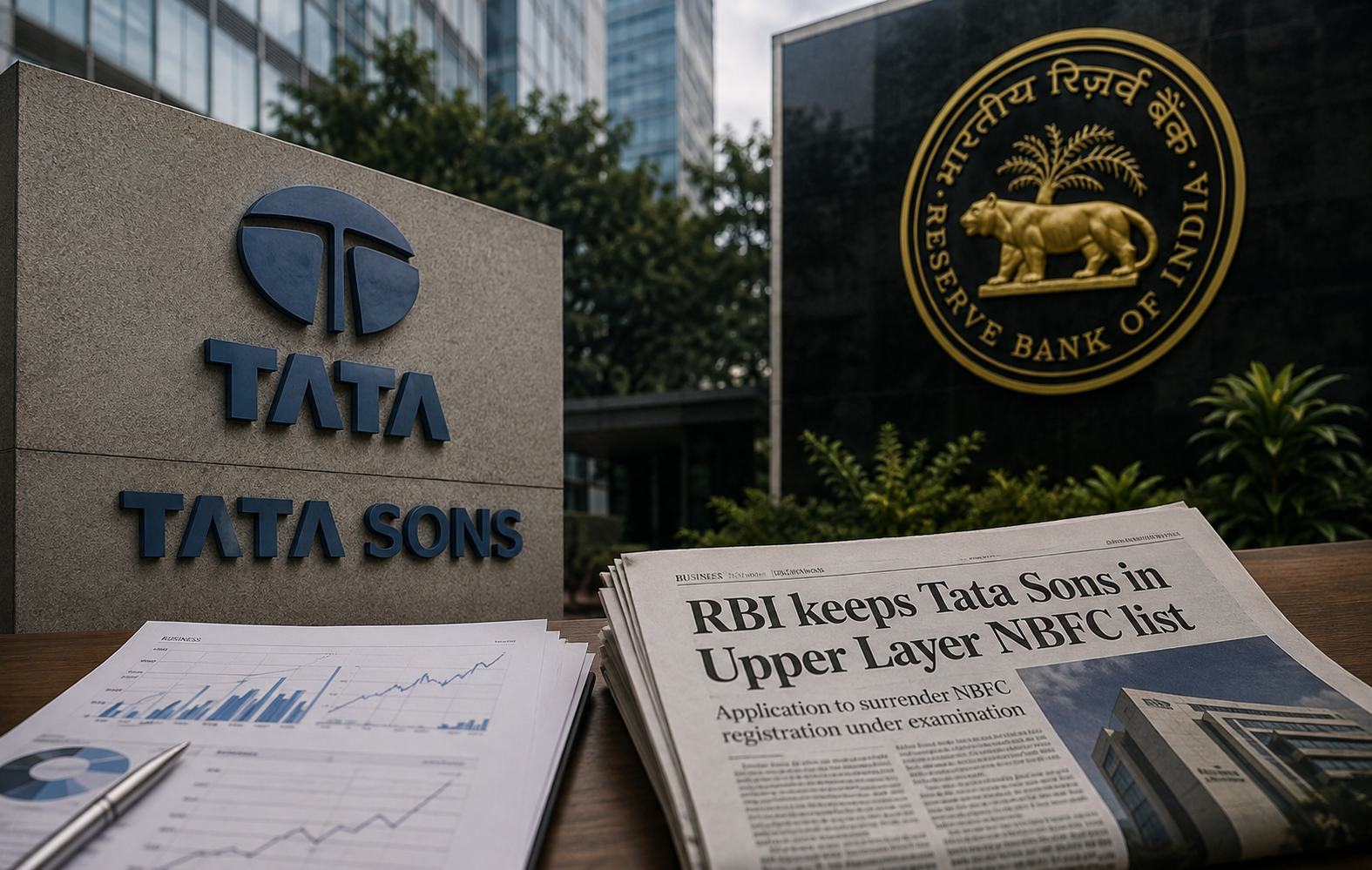
The Reserve Bank of India has kept Tata Sons Private Limited on its list of Upper Layer Non-Banking Financial Companies for FY2026–27, while confirming that Tata Sons' application to surrender its NBFC registration is still under examination. Put those two facts together and you get a question that's been simmering for a while: could Tata Sons eventually be forced to list on the stock exchanges? It's a bigger question than it sounds. Tata Sons sits at the top of the Tata Group, a business empire stretching across technology, automobiles, steel, airlines, electronics, consumer goods, and financial services. The RBI's classification pulls back the curtain on something most people never think about - why a holding company that doesn't lend money or take deposits like a bank still ends up under financial regulation, and why that regulation could ultimately decide whether it stays private or goes public. There's probably no name in Indian business more familiar than Tata. Most people brush up against it constantly without thinking twice - a Tata car in the driveway, a TCS project at work, Tata Consumer products in the kitchen, a flight on Air India, a loan from Tata Capital. But sitting above almost all of it is a company most consumers never interact with directly: Tata Sons Private Limited. Tata Sons is the principal holding company of the Tata Group. It doesn't sell cars or write code or manufacture steel itself - its role is largely about owning stakes in the companies that do, and managing the strategic interests of the group as a whole. That makes how it's owned and controlled unusually important, and it's exactly why a recent RBI decision has put the company back in the spotlight. On August 6, 2026, the RBI kept Tata Sons on its Upper Layer NBFC list for FY2026–27. That doesn't mean the RBI has turned down Tata Sons' request to give up its NBFC registration - that application is still being examined. But the distinction matters a great deal, because under the RBI's own rules, an NBFC in the Upper Layer is generally required to list within three years of being identified as such. So a fairly technical regulatory decision suddenly becomes a genuinely big business question: could Tata Sons actually be forced to go public? To make sense of why this question exists at all, it helps to understand what a holding company actually is, because it's not quite what most people picture when they hear the word "company." A car manufacturer makes cars. A software company sells software. A bank lends money. A holding company can be something else entirely - its whole purpose can simply be owning stakes in other companies, acting as the central ownership layer of a wider group. Instead of building anything itself, it holds the shares of the businesses that do, which lets a group allocate capital across different ventures, coordinate strategy at the top, and keep major assets concentrated under one roof. Tata Sons plays exactly this role for the Tata Group. And the flip side of that concentration is that a holding company's decisions can ripple outward and touch a lot of businesses at once - which is precisely the kind of thing regulators start paying attention to. So why does the RBI care about a company that doesn't function like a bank? The short answer is systemic risk. Financial systems are deeply interconnected, and when a genuinely large institution runs into trouble, the fallout rarely stays contained - lenders, investors, counterparties, and related businesses can all get pulled in. That's why regulators don't treat every financial entity the same way. The RBI built its Scale Based Regulation framework around this idea, sorting NBFCs into four layers - Base, Middle, Upper, and Top - with the Upper Layer reserved for entities that warrant closer supervision because of their scale or systemic weight. Tata Sons has sat on that Upper Layer list since it was first identified there, flagged specifically as a Core Investment Company, with the RBI noting even back in its 2024–25 list that the classification didn't prejudge the outcome of Tata Sons' deregistration request. That unresolved thread is exactly what the latest decision keeps alive. It's worth being precise about what an NBFC even is here: a company carrying out certain financial activities without operating as a conventional bank. Not all of them pose the same level of risk, though, which is why the RBI built this layered structure in the first place. The Base Layer covers lower-risk entities. The Middle Layer covers larger, more significant ones. The Upper Layer is for those that need enhanced oversight. And the Top Layer exists for situations where systemic risk climbs even higher than that. The logic underneath all of it is fairly intuitive - more potential systemic risk means stronger regulation - and for Upper Layer NBFCs specifically, that translates into tighter requirements around governance, capital, disclosures, risk management, and, critically for Tata Sons, mandatory listing within three years of identification. That single requirement is the regulatory mechanism driving the entire IPO debate. Which raises the obvious next question: why would Tata Sons want to avoid going public in the first place? An IPO changes a private company in fundamental ways. Right now, Tata Sons is privately held. Listing would open the door for outside investors to buy in through the stock market, which sounds appealing from a pure capital-markets standpoint, but it reshapes the company's entire ownership dynamic. Public shareholders acquire real economic interests. Disclosure requirements jump considerably. Financial details that were once private become visible to anyone watching. Management decisions face much closer scrutiny. The company's valuation stops being a private estimate and becomes a number the market sets every single day. And ownership that's currently concentrated among a relatively small group spreads much more widely. For Tata Sons, this cuts especially close because of Tata Trusts, which collectively hold around 66% of the company and function as its dominant shareholder. A public listing wouldn't just affect how Tata Sons is valued - it could reshape how ownership and governance work across the entire Tata Group. So this was never really a question of whether Tata Sons needs an IPO to raise money. It doesn't appear to be short on capital. The real issue is whether a company of this size and structure is required, by regulation, to become publicly traded whether it wants to or not. Here's where it gets genuinely interesting: Tata Sons has already tried a different route out of this situation. The company applied to surrender its NBFC registration entirely, a move that could, if approved, remove the regulatory trigger tied to its Upper Layer classification in the first place. It's also repaid debt as part of a broader effort to shift its regulatory standing. None of that has been resolved yet, though, which is exactly why the RBI's latest announcement carries weight - Tata Sons stays on the Upper Layer list while its attempt to exit the framework altogether remains under review. It's an unusual limbo: still bound by the rules, while the outcome of its attempt to leave them sits unresolved. Until that gets settled, the listing question stays very much alive. One thing worth clearing up: an IPO is often assumed to be about raising cash, but that's really just one reason among several. Going public can give existing shareholders liquidity, establish a publicly observable valuation, widen the ownership base, boost transparency, open a future channel for raising more capital, and create an actual market for shares that were previously hard to trade at all. The trade-off is real, though - public companies live under far heavier disclosure obligations and constant scrutiny from investors, analysts, and regulators alike. For a company sitting at the center of one of India's largest business groups, that shift in transparency could genuinely change how the market perceives the entire Tata Group. Tata Sons would stop being valued through private deals and analyst guesswork and start being priced continuously by the market itself, based on its assets, dividends, investment decisions, and strategic direction. That opens up an interesting wrinkle around market valuation. Tata Sons holds stakes in a long list of valuable businesses, and if it were listed, the market would inevitably start comparing the value investors assign to Tata Sons itself against the combined value of everything it owns underneath. These comparisons often produce what analysts call a holding-company discount - where the parent trades for less than the sum of its parts, because investors factor in taxes, holding-company overhead, governance layers, debt, restrictions on distributing capital, and the simple fact that shareholders in the parent don't get to directly control the businesses beneath it. A Tata Sons listing would be a genuinely fascinating real-world test of how markets price a corporate structure this complex. Zoom out, and the Tata Sons situation says something bigger about how financial regulation works today. Regulators aren't only watching companies that take deposits or hand out loans directly to consumers - they're increasingly focused on institutions whose sheer size, interconnectedness, or structural complexity could create risk elsewhere in the system. That's the entire premise behind the RBI's Upper Layer framework. It isn't really designed to stop large companies from growing; it's designed to make sure that growth doesn't create blind spots nobody's watching. As companies scale up and become more tightly woven into the broader financial system, regulators lean harder into questions of governance, risk management, capital adequacy, and transparency. Tata Sons is a clean example of how a company's own structure can become the regulatory issue itself - the company may see itself primarily as a holding entity, while the regulator sees the same organization through the lens of systemic financial risk. Both readings can be legitimate at once, and that tension is really what makes this story worth following. So where does this leave things? There's no confirmed IPO date, and the RBI's latest move doesn't force Tata Sons to launch one tomorrow. For now, the company simply stays on the Upper Layer list while its deregistration application continues to sit under review. The next real signal will likely come when the RBI actually rules on that application. If it's approved, the listing pressure could ease considerably. If Tata Sons stays classified as an Upper Layer NBFC, the mandatory listing clock keeps ticking in the background. Either way, it's a situation worth watching - not because an IPO is guaranteed, but because however this resolves, it's likely to become one of the more instructive examples in Indian business of how regulation, ownership, and corporate strategy collide. Underneath all of it is a fairly simple idea: a company's legal structure can matter just as much as its products. The Tata Group is built from dozens of major businesses, but it's the ownership threads connecting them that determine how capital, control, and governance actually move through the group. The RBI's involvement is a reminder that these structures don't exist in a vacuum - as companies grow larger, more interconnected, and more financially significant, regulators start looking not just at what a company does, but at how it's built and what risks that architecture creates. Which is why this story was never really just about a possible IPO. It's a story about where corporate strategy, financial regulation, ownership, and capital markets all meet - and maybe the more interesting question isn't whether Tata Sons eventually lists. It's this: at what point does a private company become so economically significant that staying private stops being just a business decision?

Tags

Tata Sons, RBI, Tata Group, NBFC, Upper Layer NBFC, IPO, Corporate Governance, Holding Company, Business Strategy, Corporate Finance, Financial Regulation, Capital Markets, Tata Trusts, Indian Business, Scholarsview, Keshav Kumar ray

Written by

Keshav Kumar Ray

Keshav Kumar Ray

Finance Buisness

Finance is much more than numbers; it is the story of every economic decision. Being a finance writer for ScholarsView, I examine current financial news and discuss economic concepts behind those events. The idea is to turn such complex notions as inflation, RBI decisions, banking, financial markets, corporate finance and so forth into simple and understandable knowledge. Every article addresses two main questions: What is going on? Why is it going on?

View Profile →