BusinessYour Retirement Money Is at Risk? The Finance Lesson Behind the Latest EPFO Investigation
Published on 8/10/2026
Summary
A recent investigation involving EPFO-linked investments has sparked important
questions about pension fund safety. Here's how retirement money is invested,
protected, and what every investor can learn from the case.
The latest EPFO-related investigation has brought pension fund governance into the
spotlight. While the legal proceedings are still underway, the case raises an important
question: how can retirement savings become exposed to financial risk? This article
explains how EPFO invests employee contributions, why pension funds don't simply
keep money in bank accounts, the difference between investment risk and fraud, and
the safeguards designed to protect millions of Indian workers. It also highlights the key
financial lessons every investor should understand about risk, governance,
diversification, and long-term wealth creation.
Imagine working for 35 years, setting aside a slice of your salary every single month,
trusting that it's building toward something safe. Then one morning, a headline
mentions an investigation into alleged irregularities involving pension-linked funds
worth over ₹1,800 crore. The first thought that crosses almost anyone's mind is simple
and a little unsettling: can our retirement savings actually be at risk?
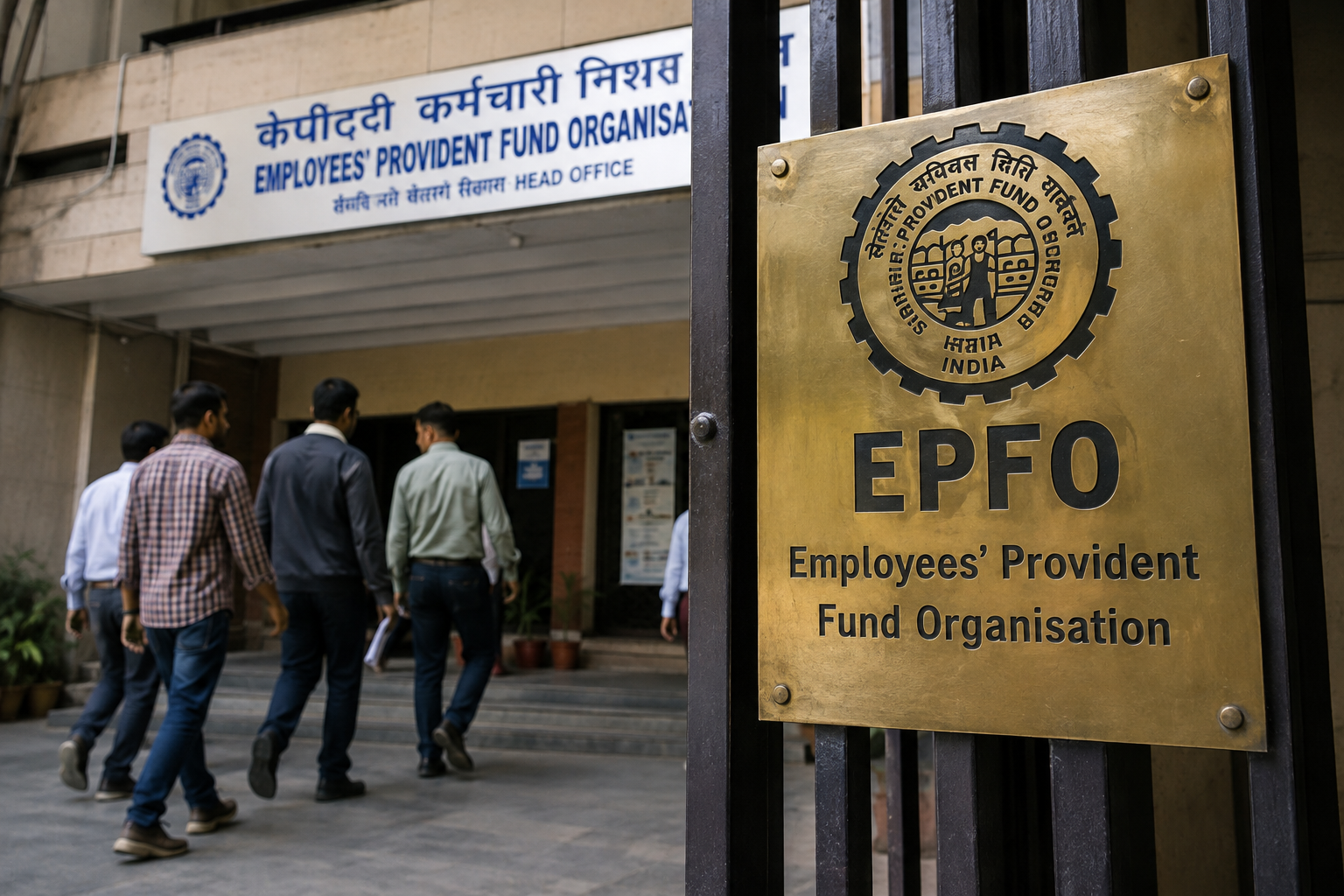
The Central Bureau of Investigation has registered a case involving alleged irregularities
tied to investments linked to the Employees' Provident Fund Organisation, Reliance
Capital, and several individuals. The allegations are still under investigation and the
legal process is ongoing, so nothing here is settled fact yet. But the news is a genuinely
useful excuse to step back and ask a bigger question: how does pension money actually
get invested, and what stands between it and situations like this?
Start with the basics. EPFO is India's largest retirement savings institution, and the way
it works is familiar to almost every salaried employee - a portion of your salary goes in
every month, your employer matches with a contribution of its own, and the money
quietly compounds for decades until you draw on it after retirement or under specific
withdrawal rules. Scaled up across the workforce, EPFO now manages retirement
savings running into tens of trillions of rupees, making it one of the largest institutional
investors in the country. Because that money belongs to millions of ordinary workers,
not shareholders chasing upside, keeping it safe isn't just a priority - it's the whole point.
Which raises an obvious question: why not just park all of it in a bank account and be
done with it? Because inflation doesn't wait around. If prices are rising 6% a year and a
savings account is paying out 3%, the real value of that money is quietly shrinking even
as the number on the statement goes up. So pension funds invest - carefully, and with
capital preservation as the north star rather than chasing the highest possible return. In
practice that usually means government securities, high-rated corporate bonds, public
sector instruments, and a limited, tightly regulated slice of equity exposure. The goal
was never to maximize profit. It was to strike a balance between safety and growth that
keeps pace with inflation without gambling with people's futures.
So where do things go wrong? Risk, in one form or another. Any time money is invested
anywhere, there's some chance the outcome doesn't go as planned - a company
performs well, or it doesn't; governance holds up, or it quietly erodes; and occasionally,
fraud enters the picture. If an entity that received pension money later runs into serious
financial trouble, those investments can take a hit. That's exactly why institutional
investors put so much effort into due diligence before money ever changes hands - not
because it eliminates risk, but because it's the best defense against it.
It's worth being precise here, because this distinction gets blurred constantly in
headlines: an investment loss and fraud are not the same thing. Businesses fail for all
kinds of ordinary reasons - an economic slowdown, weak management, too much debt,
a market that shifted underneath them, competitors that got there first. None of that is
fraud. Fraud specifically involves intentional deception - misrepresenting facts or hiding
material information on purpose. That's precisely why investigations exist in the first
place: to work out whether a loss came from ordinary business risk, from governance
failures, or from someone actually breaking the law. Jumping straight to "fraud" the
moment a headline mentions an investigation skips over that whole process.
This is also why pension funds operate under much tighter rules than, say, a venture
capital fund chasing the next big bet. Their first job isn't growth - it's protecting the
money contributors have already handed over. So before committing capital, they
typically look hard at a handful of things: whether the borrower can actually repay what
it owes, whether the company is generating real, sustainable cash rather than just
reporting good numbers, whether management is transparent about how it operates,
whether it's complying with the regulations that apply to it, and whether the fund is
spreading its money widely enough that no single bad outcome can do outsized
damage. None of this makes losses impossible. It just makes them less likely, and
easier to catch early when they do happen.
When something does go wrong, the process that follows tends to be fairly structured -
investigations, forensic audits, attachment of assets where the law allows it, recovery
proceedings, sometimes court-supervised resolution. The point of all of it is the same:
figure out who's accountable, and recover as much as possible for the people the
money actually belongs to.
There's a version of this story that applies well beyond EPFO, too - a handful of lessons
any individual investor can take from it. Chasing high returns without understanding the
risk attached to them is usually a losing habit, because the two nearly always move
together. Spreading money across companies, sectors, and asset classes rather than
concentrating it in one place isn't just textbook advice - it's the same principle pension
funds themselves rely on. A company can post strong profits and still be sitting on
serious governance problems that only surface later, so profit alone was never the
whole picture. Real financial strength shows up in sustainable cash flow, not just in the
number at the bottom of a results announcement. And maybe most importantly: an
investigation is not a conviction. It's the system doing its job of establishing what
actually happened, and treating it as proof of guilt before that process finishes gets the
causality backwards.
For the millions of Indians who contribute to EPFO year after year without giving it much
thought, understanding how that money is actually managed does two things at once - it
builds real confidence in the system, and it equips people to ask better, more informed
questions about governance, transparency, and risk when something like this makes the
news. Long-term protection for retirement savings ultimately comes down to strong
oversight, sensible investment policy, and genuine accountability - not the absence of
risk, which was never realistically on the table.
News about financial investigations tends to trigger anxiety first and understanding
second, but it doesn't have to stay that way. Whether you're a salaried employee
contributing to EPFO every month, an investor building your own portfolio, or just
someone trying to make sense of how the financial system actually works, the lesson
underneath a story like this is the same one it always is: protecting wealth was never
only about chasing higher returns. It's about understanding the risk you're actually
taking, expecting transparency from the people managing your money, and making
decisions with your eyes open rather than on faith alone.Tags
EPFO, Employees' Provident Fund Organisation, Reliance Capital, Anil Ambani, CBI, Pension Fund, Retirement Planning, Corporate Governance, Financial Fraud, Investment Risk, Personal Finance, Corporate Finance, Risk Management, Current Affairs, Finance Explained, ScholarsView, CA Aniket Kumar Written by

CA Aniket Kumar
Audit and Finance
I am a Chartered Accountant and Consultant at Grant Thornton Bharat LLP, with professional experience in audit, financial reporting, risk advisory, and corporate finance.
As an author at ScholarsView, I write about finance, business, economics, taxation, financial markets, and corporate developments. My focus is not just on reporting what happened, but on explaining the why behind the headlines.
I aim to simplify complex financial and business topics and make them practical and accessible for students, professionals, investors, and anyone interested in understanding how businesses, markets, and the economy actually work.
Chartered Accountant | Finance & Business | Audit & Risk Advisory | Author at ScholarsView
View Profile →