BusinessIndian IT Stocks Are Falling, But Their Businesses Are Improving. How Is That Possible?
Published on 8/10/2026
Summary
Indian IT stocks have remained under pressure despite relatively stable Q1 FY27 results and improving deal activity. The disconnect offers an important lesson about how investors value businesses, and why a good company can sometimes have a disappointing stock price.
Indian IT stocks have stayed volatile even as the sector's underlying business shows real signs of improvement. Q1 FY27 was a relatively stable quarter across the board, with companies continuing to execute large deals despite clients keeping a cautious hand on spending. Analysts expect growth to pick up as existing deal pipelines gradually convert into revenue, alongside steady demand for cloud, AI, and digital transformation work.
Which leaves an odd puzzle sitting in plain sight. If IT companies are winning big contracts, holding margins steady, and building healthy pipelines, why aren't their stocks consistently rewarding investors for it? The answer comes down to a distinction that trips up even experienced investors: the difference between how a business performs and how its stock performs. A share price was never a scorecard for the quarter that just ended - it's a bet on everything the company might earn from here on out, how fast that growth can realistically happen, what could derail it, and how much investors are willing to pay today for profits that haven't arrived yet. Indian IT is turning into a genuinely useful case study in how expectations, valuation, AI, and global spending patterns all collide.
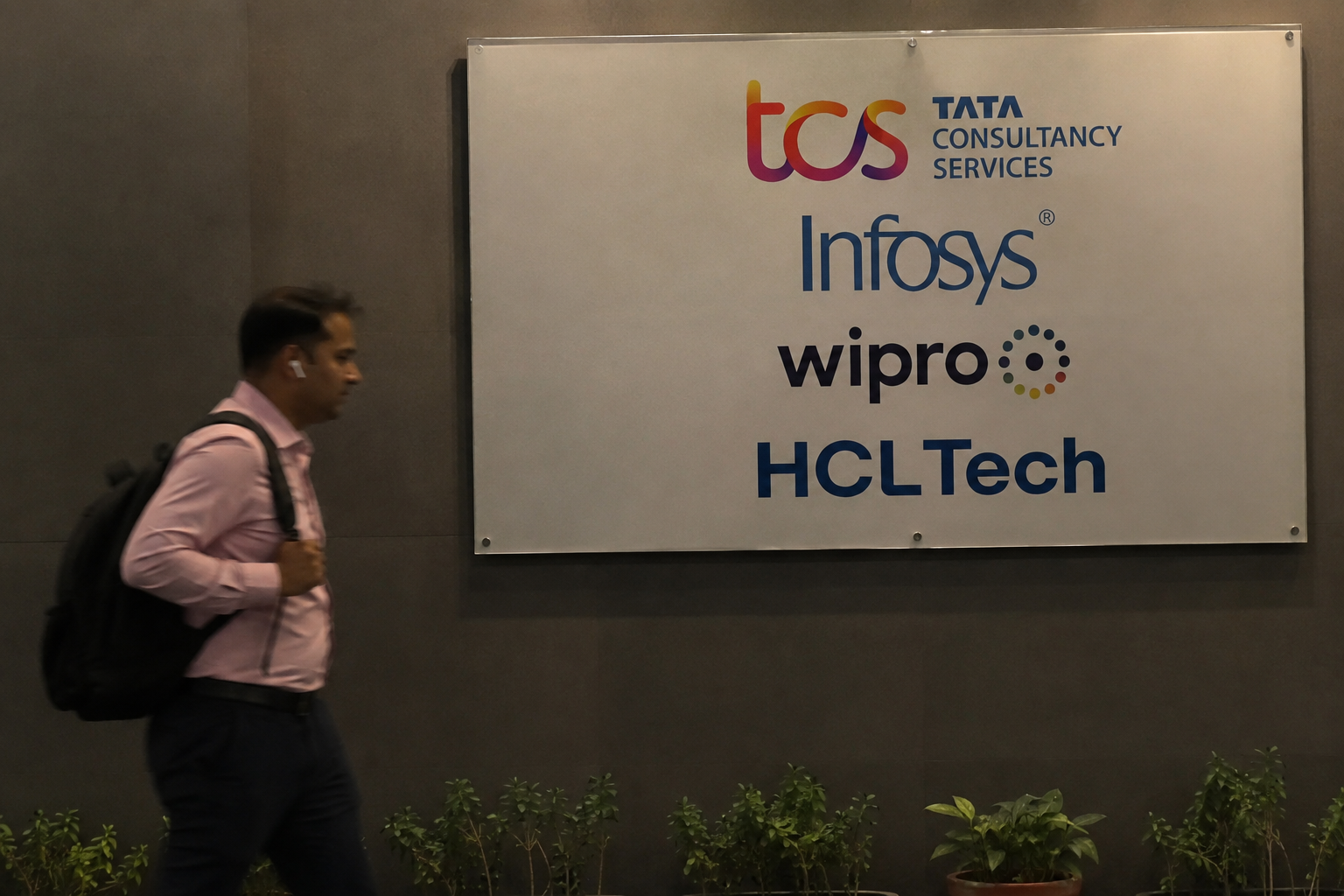
For decades, India's IT industry has been one of the country's strongest bridges to the global economy. TCS, Infosys, HCLTech, Wipro, and Tech Mahindra built enormous businesses on a fairly simple advantage - global companies could outsource technology work to India at a lower cost while tapping into a genuinely deep pool of skilled talent.
That industry is now moving through a very different phase. AI is reshaping how software actually gets written. Cloud computing has become the default, not the exception. Clients have grown pickier about where their technology budgets go. Global economic uncertainty is making companies think twice before greenlighting big discretionary projects. And yet, through all of that, India's IT companies are still landing major contracts - which sets up a genuinely strange situation in the stock market: the businesses look resilient, but the stocks keep swinging.
Recent numbers back that up. TCS reported Q1 FY27 revenue of $7.624 billion, up 2.7% year-on-year in dollar terms, with an operating margin holding at 24%. Its total contract value for the quarter came in at $9.5 billion, and its annualised AI revenue reached $2.6 billion. Tech Mahindra had a strong quarter too, with revenue up 6.1% year-on-year in constant-currency terms and EBIT climbing 38.6%. New deal wins hit $1.078 billion, up 33.3% from a year earlier. None of that reads like a sector on the verge of collapse - so why are investors still nervous?
It starts with one of the most misunderstood ideas in investing: a stock isn't a report card for the past. It's a price placed on the future. Say an IT company earns ₹100 crore this year - sounds like good news on its own. But if investors had already priced in expectations of ₹110 crore, the stock can still fall, because ₹100 crore came in worse than what the market had already baked into the share price. Flip it around: a company that earns ₹90 crore when investors expected only ₹75 crore can see its stock jump, even though it made less money in absolute terms than the first company did. That's performance versus expectations, and it explains a huge chunk of the volatility sitting on top of Indian IT stocks right now.
When analysts actually sit down to evaluate an IT company, they don't stop at revenue and profit. They're asking how fast revenue can realistically grow next year, whether margins have room to improve, how deep the order pipeline runs, whether clients are actually opening up their technology budgets, whether AI ends up creating new revenue streams or quietly eating into demand for traditional services, whether pricing power can hold, what happens if the US economy cools off, what happens to employee costs, and whether AI-driven productivity means the company eventually needs fewer people to do the same work. Every one of those questions feeds into valuation, which is exactly why a stock price can move in a completely different direction from the quarter's actual results. The market is really trying to estimate future cash flows, and that matters more for IT companies than for most businesses, because so much of their value sits in things you can't put on a factory floor - people, intellectual property, client relationships, contracts, technical capability. A manufacturer has machines and buildings an investor can look at and reasonably size up. An IT company's most valuable assets are largely intangible, which hands enormous power to expectations about what those assets can generate down the road.
One of the clearest signals investors lean on here is Total Contract Value, or TCV. An IT company can sign a massive multi-year deal today and only recognize the revenue from it gradually, spread out over years - which means deal wins and immediate revenue are two very different things. Sign a $1 billion, five-year contract, and that doesn't mean $1 billion shows up on this quarter's income statement. It means future revenue potential, not present-day cash. That's why analysts track both current revenue growth and fresh deal wins side by side. The Q1 numbers show exactly why the distinction matters - TCS posted $9.5 billion in TCV, while Tech Mahindra's new deal wins climbed more than 33% year-on-year to $1.078 billion. Both numbers offer real visibility into future business. But the market still asks the harder follow-up question: how quickly will those contracts actually turn into revenue? If conversion drags on longer than expected, investors get restless - which is a big reason IT stocks can stay choppy even when the order book looks genuinely healthy.
Then there's AI, which has made valuing this sector noticeably harder. It's both an opportunity and a threat wrapped into one. On the opportunity side, businesses everywhere are pouring money into AI transformation, cloud infrastructure, automation, data platforms, and cybersecurity, and Indian IT firms are well positioned to capture a real slice of that spending - TCS alone reported $2.6 billion in annualised AI revenue in Q1 FY27, including an $800 million AI-led transformation deal with SKF. But AI also raises an uncomfortable question underneath all that opportunity: if AI lets a software engineer finish in two hours what used to take eight, what happens to the traditional outsourcing model that Indian IT was largely built on? There are genuinely two ways this can go. IT companies could squeeze more value out of every employee and see margins improve. Or clients, aware that software development just got a lot more efficient, could simply demand lower prices and keep the savings for themselves. Both outcomes are plausible, and that uncertainty is a real reason investors hesitate to hand out sky-high valuations even when current financial performance looks perfectly healthy. The market isn't really asking whether AI helps Indian IT - it's asking who actually captures the economic value AI creates. Service providers? Clients? The technology companies building the AI tools? Or does competition eventually just push prices down for everyone? None of that gets answered by one good quarter.
Global exposure adds another layer entirely. Indian IT companies are headquartered in India, but the bulk of their revenue comes from overseas, particularly the US and Europe - a business model that lets them tap competitively priced local talent while earning in foreign currency, but also ties their fortunes tightly to economic conditions well outside their control. When a US company starts worrying about its own revenue growth, discretionary technology spending is often the first thing to get pushed back. A cloud migration can wait. A consulting engagement gets delayed. A transformation programme gets rolled out in slower phases instead of all at once. That sets off a fairly predictable chain - global uncertainty leads to cautious corporate spending, which delays IT projects, which slows deal conversion, which eventually shows up as slower revenue growth - even when the Indian companies themselves are executing well. Which is exactly why investors keep half an eye on US economic indicators when they're trying to value Indian IT stocks. Part of this industry's future gets decided thousands of kilometres away from Bengaluru, Hyderabad, Pune, and Chennai.
Margins matter just as much as growth, even though growth usually grabs the headlines. Picture two companies: Company A grows revenue 10% but watches its operating margin slip from 25% to 20%. Company B only grows revenue 6%, but expands its margin from 20% to 25%. Which one actually created more value? It's not obvious without looking at the full picture. IT companies carry heavy employee-related costs, so if salaries climb faster than revenue, margins get squeezed - but if AI and automation let a company deliver more work without a proportional jump in headcount costs, margins can actually widen. That's why investors watch operating margins closely. TCS's 24% operating margin in Q1 shows the value of holding profitability steady through an uncertain demand environment, and Tech Mahindra's EBIT margin climbed meaningfully year-on-year to 14.4% - both signs that cost discipline and operational efficiency are still generating real value even when top-line growth stays moderate.
Put all of this together, and the apparent contradiction starts making sense. A company can win big contracts, expand margins, generate strong cash flow, grow its AI business, and keep a healthy balance sheet - and its stock can still fall. Why? Because investors may simply have expected more. Maybe the market was pricing in 8% growth and the company delivered 5%. Maybe margin expansion was supposed to move faster. Maybe management issued cautious guidance for the next quarter. Maybe global tech spending is expected to soften. Or maybe - and this one matters more than people give it credit for - the stock was just trading at a very rich valuation to begin with. A great business does not automatically make a great investment, because price matters enormously. If a company is valued at ₹1,000 billion on the assumption that it'll keep growing rapidly for years, even a small stumble can trigger an outsized drop in the share price. The business itself might still be excellent. The valuation attached to it may simply have gotten ahead of reality.
This gets at one of the more counterintuitive lessons in equity investing: a good company and a good stock aren't the same thing. Picture Company X, an outstanding business - growing revenue, strong margins, a healthy balance sheet - trading at 50 times expected earnings. Now picture Company Y, a fairly average business with slower growth and thinner margins, trading at just 12 times earnings. If Company X delivers even slightly disappointing growth, its valuation can contract sharply, because so much optimism was already baked in. Company Y has far less room to disappoint investors, simply because expectations were modest to begin with. Business quality and investment return aren't the same variable - a stock's return depends just as much on the price you paid for that quality as on the quality itself. That's a big part of why Indian IT stocks can stay volatile even while the underlying businesses keep performing reasonably well.
So what do the latest results actually tell us? Not a clean "bullish" or "bearish" story - more a picture of an industry mid-transition. Traditional outsourcing still matters. Cloud demand keeps growing. AI is opening genuinely new revenue lines. Clients remain cautious with their budgets. Deal pipelines look healthy. Margins are being watched closely. And investors are still trying to work out how much of the future growth story is already baked into today's share prices. Recent sector analysis suggests healthy deal pipelines and rising cloud and AI demand could support stronger growth ahead, though how fast those deals actually convert into revenue remains the open question. That uncertainty is exactly what fuels the volatility. Markets tend to dislike uncertainty on principle - but uncertainty doesn't automatically mean weakness. Sometimes it just means investors haven't yet agreed on what happens next, and right now the IT industry sits right in the middle of one of the bigger technological shifts modern business has seen in a while.
There's a lesson here that goes well beyond technology stocks specifically. It's tempting to look at revenue growth, profit, and a quarter's results and conclude, simply, whether a business is doing well or not. Investors operate one level deeper than that - they're asking what those numbers imply about everything still to come. A stock price is really a blend of current performance, future expectations, risk, and valuation all rolled together, which is exactly why a genuinely strong company can watch its stock fall while a struggling one occasionally sees its shares climb. The market was never just rewarding what already happened. It's constantly repricing what investors believe is coming next.
For India's IT companies, that future is being shaped by AI, cloud adoption, global spending patterns, employee productivity, and - perhaps above all - the ability to actually convert enormous deal pipelines into sustainable revenue and profit over time. The companies that navigate that transition well may well come out stronger on the other side. But whether their stocks deliver strong returns for investors depends on an entirely separate question: how much of that better future is already sitting inside today's share price? That gap - between understanding a company and understanding its stock - is really the whole story here.Tags
Indian IT, TCS, Infosys, HCLTech, Wipro, IT Stocks, Q1 FY27, Business Strategy, Stock Market, Corporate Earnings, Artificial Intelligence, Cloud Computing, Deal Wins, Valuation, Technology Sector, Indian Economy, Investing, ScholarsView, keshav kumar rayWritten by

Keshav Kumar Ray
Finance Buisness
Finance is much more than numbers; it is the story of every economic decision.
Being a finance writer for ScholarsView, I examine current financial news and discuss economic concepts behind those events. The idea is to turn such complex notions as inflation, RBI decisions, banking, financial markets, corporate finance and so forth into simple and understandable knowledge.
Every article addresses two main questions:
What is going on?
Why is it going on?
View Profile →