Why Do Governments Sell Stakes in Successful Companies Instead of Owning Them Forever? The Business Strategy Behind LIC's Share Sale
Business

Why Do Governments Sell Stakes in Successful Companies Instead of Owning Them Forever? The Business Strategy Behind LIC's Share Sale

Published on 8/4/2026

Summary

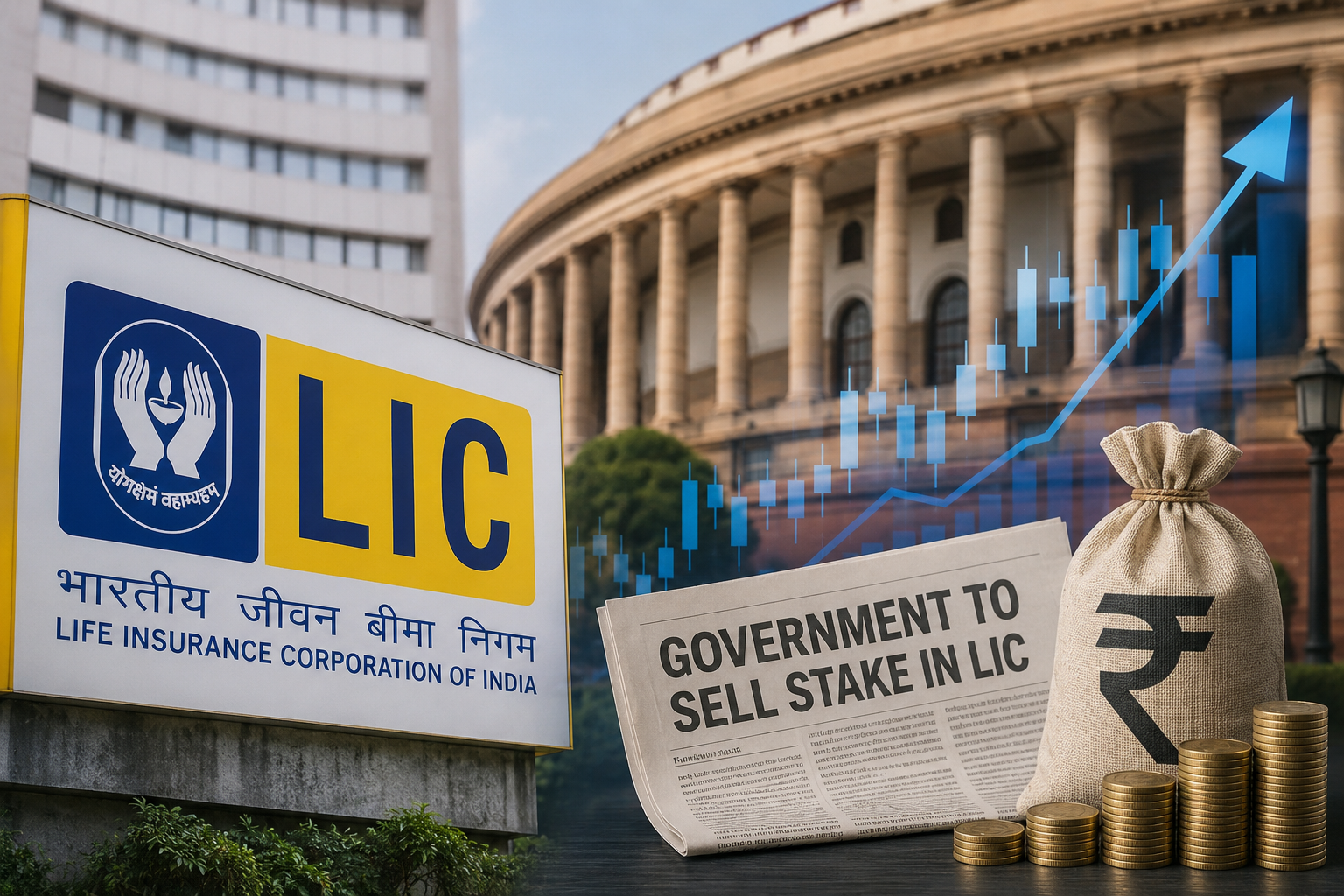
The Government of India has launched an Offer for Sale to divest up to 6.5% of its stake in Life Insurance Corporation of India. If fully subscribed, it could raise over ₹31,000 crore and lift LIC's public shareholding from 3.5% to 10%, helping the company meet SEBI's minimum public shareholding requirement ahead of the May 2027 deadline. For a lot of people, the news raises an obvious question: if LIC is profitable and strategically important, why sell any of it at all? The answer comes down to a distinction that's easy to miss - the difference between owning a company and actually creating value through it. Governments around the world routinely trim their stakes in successful enterprises, not because those companies are struggling, but because market development, capital allocation, governance, and fiscal priorities often matter more than holding on to every last share.

When people hear that a government is selling shares in one of its own companies, the instinctive reaction is usually surprise. If the company's profitable, has millions of customers, and dominates its market, why would you ever let go of a piece of it? It's a fair question on the surface. But governments do this all the time, and India's latest move with LIC is a textbook case. The government has launched an Offer for Sale to shed up to 6.5% of its stake, a move expected to push LIC's public shareholding from 3.5% up to 10% - bringing it in line with SEBI's listing rules while also feeding into the government's broader divestment plans for the year. To most investors watching the ticker, this looks like a straightforward share sale. It's really something more interesting: a working example of one of the core ideas in public-sector strategy - that the goal was never to maximize ownership for its own sake, but to maximize the value the economy gets out of that ownership over time. Picture a government holding 100% of a large company. Every strategic call, every rupee of capital required, every bit of financial risk sits entirely on the government's books. Total control, sure - but also total concentration of risk in one place. Now picture that same company partly owned by millions of public investors, with the government still comfortably the largest shareholder. Suddenly the company has access to a much wider pool of capital, more people have a stake in its success, and the market is constantly pricing and re-pricing its performance. The government hasn't given up its say - it's just no longer carrying the whole thing alone. That's really the whole philosophy behind divestment, and it's worth clearing up a common mix-up here: divestment and privatization are not the same thing, even though people use them interchangeably. Privatization means handing over both ownership and management control to private hands. Divestment just means owning less than you did - a government can sell down a chunk of its shares and still hold a comfortable majority. That's exactly the situation with LIC. The government isn't heading for the exit. It's simply loosening its grip a little while staying firmly in the driver's seat. Part of what's pushing this particular sale is fairly mundane: regulatory compliance. SEBI requires listed companies to keep a minimum share of stock in public hands, so there's always enough floating around for healthy trading. When only a sliver of a company's shares are actually available to trade, liquidity dries up and price discovery gets murky. Right now, only about 3.5% of LIC's shares sit with the public. This OFS is designed to get that number to 10%, clearing the bar SEBI has set. But compliance is really just the trigger here, not the whole story. The bigger idea is capital allocation. Governments, like any business, work with finite resources, and every rupee parked in one asset is a rupee that can't go anywhere else. If part of a mature holding like LIC can be converted into cash, that money can flow toward infrastructure, healthcare, education, defence, renewable energy - wherever it's needed most. In the corporate world, this is called capital recycling: businesses regularly sell off mature, slower-growing units to fund the next phase of growth. Governments increasingly think the same way, and this LIC sale sits squarely inside India's broader divestment and asset monetisation push for the year. There's also a governance angle that's easy to underrate. Once a company is listed and trading publicly, it lives under constant scrutiny - quarterly results, mandatory disclosures, independent directors, institutional investors asking hard questions, analysts picking apart every decision. That kind of transparency tends to sharpen accountability. A company answerable to thousands of shareholders usually faces tougher governance expectations than one answerable to a single owner. So broadening public ownership doesn't just help with liquidity - it tends to build trust as well. The market itself benefits too, in a fairly mechanical way. Think about a stock where nearly every share sits locked up with one owner and only a tiny sliver actually trades. Small trades can swing the price wildly because there's so little supply to absorb them. Widen the pool of publicly held shares, and you get more buyers, more sellers, healthier volumes, and prices that actually reflect real demand rather than the quirks of a thin market. That's what economists mean by improving liquidity - and it's a big part of why governments keep trimming stakes even when they have zero intention of giving up control. Which points to something worth sitting with: ownership and control aren't the same thing. A company doesn't need to hold 100% of an asset to steer its direction. Founders routinely end up owning well under half their own startups after a few funding rounds, yet they still run the show, because real control comes from governance structures as much as from raw ownership percentage. Governments operate on the same logic - you can sell down your stake considerably and still call the shots where it matters. History backs this up. Over the last three decades, governments across Europe, Asia, and Latin America have gradually pared back their stakes in airlines, telecom firms, banks, energy companies, and insurers, and a lot of those businesses actually got stronger once broader public ownership pushed better governance, sharper operations, and easier access to capital. India's walked this path before too - Coal India, NHPC, Indian Railway Finance Corporation, and now LIC. None of this is without friction, though. Governments typically price these offers at a discount to get investors interested, and that can put temporary pressure on the stock. That's more or less what happened here - LIC's share price dropped after the OFS was announced, as the market absorbed the discount. But it's worth separating short-term price noise from long-term structural change. A discounted sale can dent the price for a few days or weeks, while the resulting boost in liquidity and institutional interest can strengthen the company's footing for years. Not every dip in share price says something about the underlying business - sometimes it's just the market reacting to the mechanics of a transaction, not the fundamentals. So this isn't really a story about raising money. It's a story about how public-sector ownership has evolved - balancing strategic control against market participation, regulatory obligations, capital efficiency, and governance, all at once. For a long time, the assumption was that owning more automatically meant more economic strength. The thinking now is more nuanced: what matters isn't how much a government owns, but how effectively those assets generate value for the people who ultimately depend on them. Sometimes that means funding a highway. Sometimes it means backing the next growth sector. And sometimes it just means letting ordinary citizens become shareholders in a company the state used to hold almost entirely on its own. That's probably the real story hiding behind today's LIC headline. The bigger picture here goes well beyond one insurance company or one transaction. It's part of a broader shift in how modern economies think about ownership altogether. Success, increasingly, isn't measured by how much you hold onto - it's measured by how well you allocate resources, strengthen governance, attract investment, and build value that lasts. Whether it's a government paring down a stake in a state-run enterprise, a founder bringing in investors, or two companies forming a strategic partnership, the underlying idea keeps showing up in the same form: the smartest organizations don't try to own everything forever. They focus on building the kind of systems that keep creating value long after the ownership chart stops mattering as much.

Tags

LIC, Government Divestment, Offer for Sale, OFS, Public Shareholding, Corporate Governance, Privatization, Business Strategy, Government Policy, Capital Markets, SEBI, Business Explained, ScholarsView

Written by

Keshav Kumar Ray

Keshav Kumar Ray

Finance Buisness

Finance is much more than numbers; it is the story of every economic decision. Being a finance writer for ScholarsView, I examine current financial news and discuss economic concepts behind those events. The idea is to turn such complex notions as inflation, RBI decisions, banking, financial markets, corporate finance and so forth into simple and understandable knowledge. Every article addresses two main questions: What is going on? Why is it going on?

View Profile →