Volkswagen and JSW: Why Global Companies Need Local Partners to Win in India
Business

Volkswagen and JSW: Why Global Companies Need Local Partners to Win in India

Published on 7/24/2026

Summary

The proposed Volkswagen–JSW partnership is more than an investment deal. It reflects a fundamental business strategy that has shaped the success of multinational companies across the world.

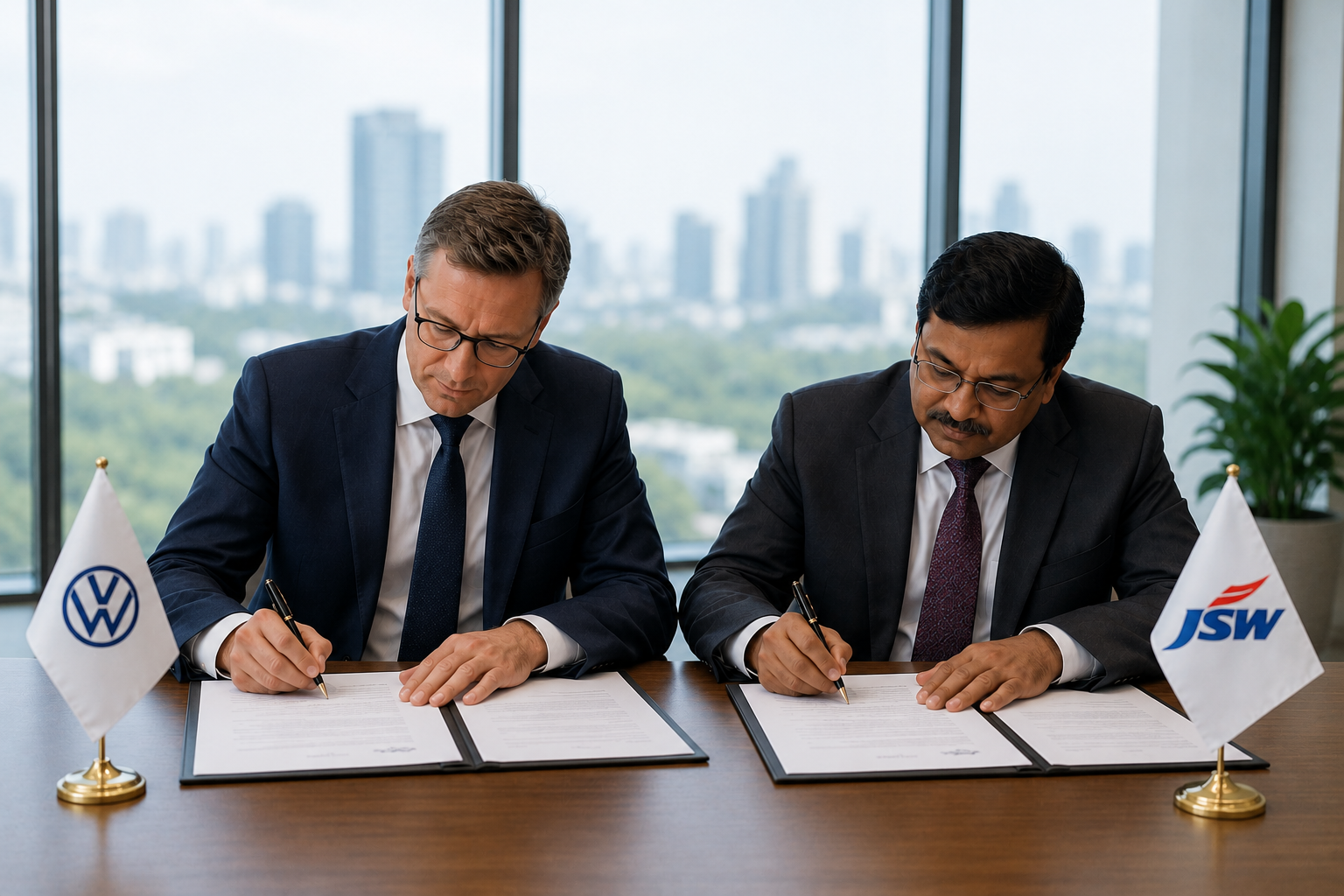
German automaker Volkswagen AG is reportedly in advanced talks with India's JSW Group for a strategic investment in its Indian operations. According to multiple reports, JSW could acquire a significant stake in Skoda Auto Volkswagen India, injecting fresh capital while helping Volkswagen strengthen its footing in one of the world's fastest-growing automobile markets. Negotiations are still ongoing and no final structure has been announced, but the development raises a broader question: why do some of the world's biggest companies seek local partners instead of expanding on their own? The answer extends well beyond the automobile industry. It's rooted in market entry strategy, local expertise, risk sharing, regulatory navigation, and long-term competitive advantage — and the proposed partnership offers a useful lesson in how global businesses adapt to local markets rather than simply exporting their global playbook. For decades, multinational corporations operated on a simple assumption: if a product succeeded in one country, it could succeed almost anywhere. Dominance in Europe or North America was often treated as a formula to replicate — open a factory, appoint distributors, launch a marketing campaign, and expect similar results. Reality proved far messier. Markets differ in consumer behavior, regulation, infrastructure, competitive intensity, pricing expectations, and cultural preference. A strategy that thrives in Germany can stumble in India, just as an approach that works in Japan can fail in Brazil. That reality is exactly why reports of Volkswagen's advanced talks with JSW Group have drawn attention well beyond the automotive press. The proposed investment isn't simply about ownership or capital — it illustrates one of the more durable principles in international business: global companies often need strong local partners to unlock sustained growth. Volkswagen has operated in India for years through brands including Volkswagen, Škoda, Audi, Porsche, and Lamborghini. Yet despite a formidable global reputation, its market share in India has remained modest next to domestic leaders like Maruti Suzuki, Tata Motors, and Mahindra, as well as global rivals such as Hyundai. India is now the world's third-largest automobile market, which makes it impossible for any global manufacturer to ignore — but entering a large market and actually succeeding in it are two very different challenges. That gap is precisely where the proposed partnership with JSW becomes strategically interesting. According to recent reports, Volkswagen is exploring a deal under which JSW Group would invest in Skoda Auto Volkswagen India, with discussions reportedly touching on a significant, possibly majority, stake. Negotiations over valuation and investment size continue, but both companies appear to see collaboration as a way to accelerate growth in the Indian market. At first glance, this might seem surprising — why would one of the world's largest automobile manufacturers need help in a country where it has already operated for years? The answer lies in the difference between selling products and building a business ecosystem. A successful automobile company needs far more than good cars: it depends on supplier networks, dealer relationships, manufacturing efficiency, logistics, government engagement, financing partnerships, after-sales service, and a real read on shifting consumer preferences — all of which are shaped heavily by local conditions. A local partner already understands those conditions, simply because it has spent years operating inside them. JSW is one of India's largest industrial conglomerates, with businesses spanning steel, energy, infrastructure, cement, ports, paints, and automobiles. It has more recently deepened its automotive footprint through JSW MG Motor India, giving the group real experience in vehicle manufacturing, distribution, and the fast-evolving electric mobility space. For Volkswagen, a partnership here could offer more than capital — it could bring local market intelligence, stronger supply chain relationships, faster manufacturing decisions, greater operational flexibility, and, perhaps most importantly, a sharper read on Indian consumer preferences as the company shapes its long-term strategy. This gets at something taught widely in business schools: local adaptation often creates more competitive advantage than standardization. Many multinationals start out believing they can replicate their global formula everywhere, only to discover that customers behave differently in every market. Indian consumers, for instance, tend to weigh fuel efficiency, maintenance costs, resale value, financing options, road conditions, service accessibility, and increasingly digital connectivity — priorities that demand more than engineering excellence to satisfy. They demand local understanding. That's precisely why some of the most successful international companies operating in India chose partnership over independence. Toyota entered the market through the Kirloskar Group. Suzuki transformed India's passenger vehicle landscape through its long-standing collaboration with the Indian government, eventually becoming Maruti Suzuki. Hyundai invested heavily in localized manufacturing and supplier ecosystems. MG Motor strengthened its India strategy through JSW's involvement. None of these companies leaned solely on global brand reputation — each invested in becoming part of the local business environment. This also reflects a core principle of strategy: risk sharing. Entering a new market requires substantial investment in factories, technology, distribution, marketing, and product development, and every one of those investments carries uncertainty — consumer preferences can shift, economic conditions can change, regulations can evolve, and competition can intensify. Partnering with a local company spreads both the financial risk and the operational responsibility, making expansion more sustainable while letting each partner lean into what it does best. Volkswagen brings decades of engineering expertise, globally recognized brands, research capability, and advanced manufacturing technology. JSW brings industrial infrastructure, deep domestic experience, local relationships, capital, and a sharper feel for India's evolving market dynamics. Neither company holds every capability on its own — but combined, their resources may generate more value than either could produce independently. Strategists call this complementarity: rather than competing on identical strengths, successful partnerships pair different capabilities that reinforce one another. The proposed collaboration also reflects a wider shift underway across global business. For years, multinational corporations treated emerging markets primarily as places to sell products. Increasingly, they view countries like India as strategic hubs for manufacturing, innovation, and long-term growth — a shift reinforced by India's expanding middle class, improving infrastructure, and supportive manufacturing policy. As global companies reassess supply chains in the wake of geopolitical disruption and shifting trade patterns, India has become attractive as both a production base and a consumption market, which makes local partnerships even more valuable. Building supplier trust, recruiting talent, navigating regulation, and understanding state-level industrial policy all take time — and local partners meaningfully shorten that learning curve, reducing uncertainty while speeding up execution. None of this makes partnerships a guaranteed success. Differences in corporate culture, governance structures, strategic priorities, investment timelines, and decision-making style can all create friction, and questions around valuation, ownership structure, and management control are often the hardest parts of any joint venture to resolve. Reports suggest these very issues remain under discussion between Volkswagen and JSW — a reminder that strategic alignment matters just as much as the financial terms. Whether or not this specific deal ultimately closes, the underlying business lesson holds. International expansion is no longer simply about exporting products across borders — it's about building relationships, understanding local markets, and combining global expertise with regional knowledge. Companies that grasp this are typically better positioned for durable growth than those leaning on brand recognition alone. Seen this way, the proposed Volkswagen–JSW partnership represents more than a corporate transaction — it reflects how globalization itself has evolved. Companies once expanded by asking, "How do we sell our products in this country?" Today, the more successful ones ask a different question: "How do we become part of this country's economic ecosystem?" That shift in framing may be the most valuable lesson hidden behind today's headline. For business leaders, entrepreneurs, and students alike, the story is a reminder that competitive advantage rarely comes from doing everything alone. More often, it comes from finding the right partner, combining complementary strengths, and creating value that neither organization could generate on its own. In an increasingly interconnected global economy, collaboration isn't a fallback plan — it has become one of the most powerful strategies for long-term success.

Tags

Business Strategy, Volkswagen, JSW Group, Joint Venture, India Business, Global Business, Market Entry Strategy, Corporate Strategy, Automotive Industry, International Business, Strategic Partnership, Business Explained, Scholarsview

Written by

Keshav Kumar Ray

Keshav Kumar Ray

Finance Buisness

Finance is much more than numbers; it is the story of every economic decision. Being a finance writer for ScholarsView, I examine current financial news and discuss economic concepts behind those events. The idea is to turn such complex notions as inflation, RBI decisions, banking, financial markets, corporate finance and so forth into simple and understandable knowledge. Every article addresses two main questions: What is going on? Why is it going on?

View Profile →