SEBI Wants REITs & InvITs to Invest in New Projects. Why It Matters
Policy

SEBI Wants REITs & InvITs to Invest in New Projects. Why It Matters

Published on 8/8/2026

Summary

SEBI's latest proposal could give Real Estate Investment Trusts and Infrastructure Investment Trusts greater freedom to invest in third-party projects - potentially changing how India's roads, offices and other infrastructure are financed.

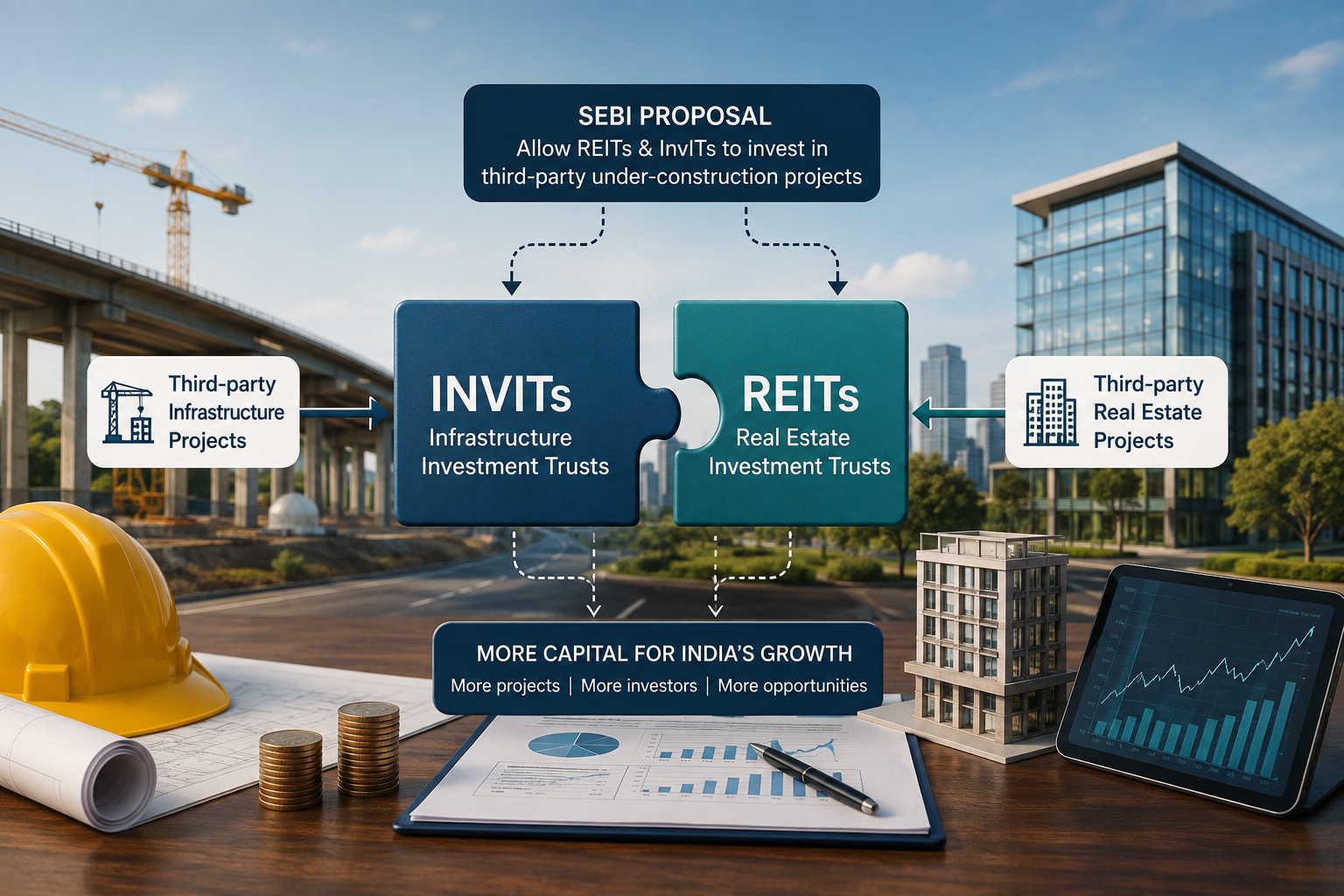
SEBI has proposed letting REITs and InvITs invest in under-construction projects built by third parties, including cases where the trust doesn't hold a controlling stake. It's part of a broader push to make these investment vehicles more flexible without giving up investor protection. It matters because REITs and InvITs were originally built to connect large, income-generating assets with investors who don't have the capital or expertise to own them outright. Give these trusts more room to participate in projects built by other companies, and their role could shift from simply holding finished, mature assets to actively funding the pipeline of infrastructure and real estate India still needs to build. Which raises a genuinely bigger question: can India's capital markets become a real engine for financing the country's infrastructure growth, not just a place to trade what's already been built? India needs an enormous amount of capital to build roads, office parks, warehouses, transmission networks, airports, and renewable energy projects. But building the assets is only half the problem - the harder question, always, is who actually pays for it. Historically, the answer has leaned heavily on banks, government spending, developers, and large institutional investors. But as the economy keeps expanding, the sheer scale of capital required is starting to outgrow any single source of financing. Which is where a fairly interesting regulatory move comes in: SEBI has proposed letting REITs and InvITs invest in select under-construction projects developed by third parties - including situations where the trust doesn't have a controlling stake in the project at all. It sounds like a dry tweak to securities regulation. It isn't. It's really about a much bigger question - how does India's financial system pull more private capital into actual physical assets, roads and buildings and power lines, rather than just paper? To see why this matters, it helps to understand what REITs and InvITs actually do in the first place. Picture owning a large commercial office building. It throws off rental income every month, sure, but buying the whole thing outright could mean finding hundreds or thousands of crores - well beyond what most individual investors can put together. A REIT changes that math entirely. Instead of one investor owning the whole property, the asset sits inside a trust, gets divided into tradeable units, and lists on the stock exchange. Suddenly you can own a slice of income-generating real estate without buying an entire building. InvITs work on the same idea, just applied to infrastructure - holding assets like roads or transmission lines and passing the resulting cash flows on to investors. Put simply, REITs turn big real estate assets into investable securities, and InvITs do the same thing for infrastructure. This matters because it bridges two groups that otherwise struggle to find each other. On one side, developers and infrastructure companies need large pools of long-term capital. On the other, investors are looking for reasonably predictable, income-producing assets. The trust structure is the thing standing in the middle, connecting them - and Indian investors have clearly shown some appetite for it. SEBI's own data shows REITs and InvITs together mobilised roughly ₹9,831.78 crore between April and June 2026, split between ₹6,005 crore through REITs and ₹3,826.78 crore through InvITs. But there's a real limitation baked into how these vehicles have worked so far. A mature office building with tenants already in place and steady rent coming in is relatively easy to value. A highway that's already operational and collecting tolls is a known quantity. A highway that's still half-built is a completely different animal - construction can slip, costs can balloon, approvals can drag on longer than anyone planned, demand forecasts can turn out to be wrong, and the project might not throw off any cash at all for years. That's exactly why regulation has traditionally kept a tighter leash on development-stage assets, and it's the problem SEBI's latest proposal is trying to solve without just throwing caution out the window. The core idea is that REITs and InvITs could put money into third-party projects without needing to control them outright. That distinction does real work. Picture a developer building a ₹10,000 crore highway. In the traditional setup, that developer puts up a big chunk of equity itself and borrows the rest from banks. Now imagine an InvIT stepping in to invest without acquiring control - the developer keeps managing construction, the InvIT supplies capital, and investors get exposure to the project's future cash flows. Risk and ownership end up spread across more participants instead of concentrated in one place. That's essentially what economists mean by financial intermediation - the financial system taking money sitting with investors and steering it toward assets that actually generate economic value. It's the whole point of capital markets, really. And a stronger REIT and InvIT ecosystem chips away at India's heavy reliance on bank lending for infrastructure, which matters more than it might seem. The traditional chain runs: banks lend, developers borrow, projects earn cash flow, debt gets repaid over time. Fine, until banks are already carrying heavy infrastructure exposure and start getting cautious about financing more of it. A deeper capital market gives developers a second lane - instead of leaning entirely on loans, they can pull in long-term institutional and retail capital through listed trusts instead. There's another benefit hiding in here too: asset recycling. Take an infrastructure company that's built and run a highway for several years already. If it wants to fund its next highway, it doesn't have to keep the existing one parked on its balance sheet forever - it can transfer that asset into an InvIT, let investors buy in for exposure to its future cash flows, and free up capital to redeploy into the next project. Real estate works the same way: a developer sitting on a mature office portfolio can unlock capital by folding those assets into a REIT, then use the proceeds to build something new. The pattern repeats - build, stabilise, monetise, reinvest, build again - and it's genuinely one of the more powerful ideas underpinning modern infrastructure finance. SEBI has been loosening the REIT and InvIT framework gradually rather than all at once. Earlier in 2026, the regulator had already approved measures around investing in greenfield infrastructure projects, liquidity management, and more borrowing flexibility for certain InvITs. The direction is pretty clear - SEBI is trying to make these structures more useful without stripping away the protections that come with being a publicly traded vehicle. But more flexibility always comes with a catch: it demands sharper risk management. Someone buying units in an InvIT might reasonably assume the underlying assets are fairly stable, since infrastructure generally means long-term, dependable cash flows. An under-construction project breaks that assumption completely - it carries real execution risk. A two-year delay on a road project pushes back the cash flows investors were counting on. A jump in construction costs can quietly wreck the project's economics. Slow approvals just mean capital sits locked up longer than expected. Which is exactly why the regulatory framework around this matters so much - the goal was never simply to let REITs and InvITs chase more assets. It's to build a structure where investors actually understand what they're buying into and what risk comes attached to it. That distinction is really what separates a healthy capital market from one that just lets money chase whatever opportunity shows up next. Step back further, and this fits into a bigger shift already underway in how India finances growth - moving gradually from a system dominated by bank lending toward one where capital markets carry more of the load. Banks aren't going anywhere, but they're no longer the only game in town. Corporate bonds, mutual funds, REITs, InvITs, pension funds, and insurance companies all now offer different routes for savings to reach productive assets. That diversification is genuinely valuable - if one funding source dries up or gets expensive, businesses have somewhere else to turn, which matters enormously for infrastructure specifically, given how much capital it needs over how many years. There's also a quieter shift happening in how Indian households might think about investing. For decades, "real estate investment" in India has essentially meant buying physical property - a large capital outlay, limited liquidity, ongoing maintenance, real transaction costs. REITs offer a genuinely different path: owning units tied to a portfolio of properties instead of an entire building. InvITs do something similar for infrastructure, letting investors participate in a highway or transmission network without ever laying a single brick. In effect, physical assets get converted into financial ones - and that's arguably the most interesting idea buried inside SEBI's proposal. Financial markets were never just about trading pieces of paper. At their best, they're mechanisms for dividing up, transferring, and financing ownership of real economic assets. A road or an office park or a transmission line is a physical thing sitting on the ground somewhere; an InvIT or REIT turns the economic rights tied to that thing into something investors can actually buy and sell. SEBI's proposal widens that bridge a little further. Done carefully, it could pull more private capital into India's infrastructure pipeline while giving developers another lever to pull for funding. None of that happens automatically, though - it depends entirely on execution. Investors need genuinely transparent disclosures. Projects need honest, realistic valuations rather than optimistic ones. Fund managers need real governance, not just a checklist. And regulators will have to make sure that "more flexibility" doesn't quietly become code for "more risk nobody's watching." That's really why this proposal is worth keeping an eye on - it isn't just about widening where REITs and InvITs can put their money. It's one piece of a much larger transformation in how India funds its own growth. As the country's infrastructure needs keep climbing, the interesting question stops being simply "how much infrastructure does India need?" It becomes something closer to: how efficiently can India's financial system actually connect long-term savings with the infrastructure the economy is waiting on? REITs and InvITs look increasingly likely to be part of that answer. Underneath all of it is a fairly simple lesson about capital allocation. A country's growth depends not just on how much it saves, but on how efficiently those savings get turned into productive investment. Banks do this through lending. Capital markets do it through securities. REITs and InvITs add one more layer - letting ordinary investors participate directly in the value generated by large physical assets that most of them will never personally own a brick of. If this regulatory framework works the way it's intended, the payoff won't just be a bigger REIT and InvIT industry - it could mean a genuinely deeper pool of domestic capital standing behind India's infrastructure ambitions. The real story here isn't that REITs and InvITs might get a bit more room to invest. It's that India is slowly building the financial infrastructure to match its physical infrastructure ambitions - and in an economy still growing this fast, that link between capital, assets, and growth might end up being one of the more important business stories of the next decade.

Tags

SEBI, REIT, InvIT, Infrastructure, Real Estate, Capital Markets, Investment Trusts, Infrastructure Investment, Real Estate Investment Trust, Business Strategy, Project Finance, Indian Economy, Financial Markets, Regulation, ScholarsView, Keshav kumar ray

Written by

Keshav Kumar Ray

Keshav Kumar Ray

Finance Buisness

Finance is much more than numbers; it is the story of every economic decision. Being a finance writer for ScholarsView, I examine current financial news and discuss economic concepts behind those events. The idea is to turn such complex notions as inflation, RBI decisions, banking, financial markets, corporate finance and so forth into simple and understandable knowledge. Every article addresses two main questions: What is going on? Why is it going on?

View Profile →