Navigating the Future of Enterprise: A Layman’s Guide to the MSME Development (Amendment) Bill 2026
Policy

Navigating the Future of Enterprise: A Layman’s Guide to the MSME Development (Amendment) Bill 2026

Published on 8/10/2026

Summary

The Parliament of India has cleared the Micro, Small and Medium Enterprises Development (Amendment) Bill 2026, marking a monumental shift in the regulatory and commercial landscape for micro, small, and medium enterprises (MSMEs). Awaiting Presidential assent, this legislation tackles the perennial bottleneck of delayed payments, strengthens alternative dispute resolution, establishes statutory permanence for digital registrations, and transitions from punitive criminal penalties to graded civil accountability. This article breaks down the core legal mechanisms of the new amendment, explaining how these reforms safeguard small business liquidity, streamline dispute resolution, and foster an environment of trust-based ease of doing business.

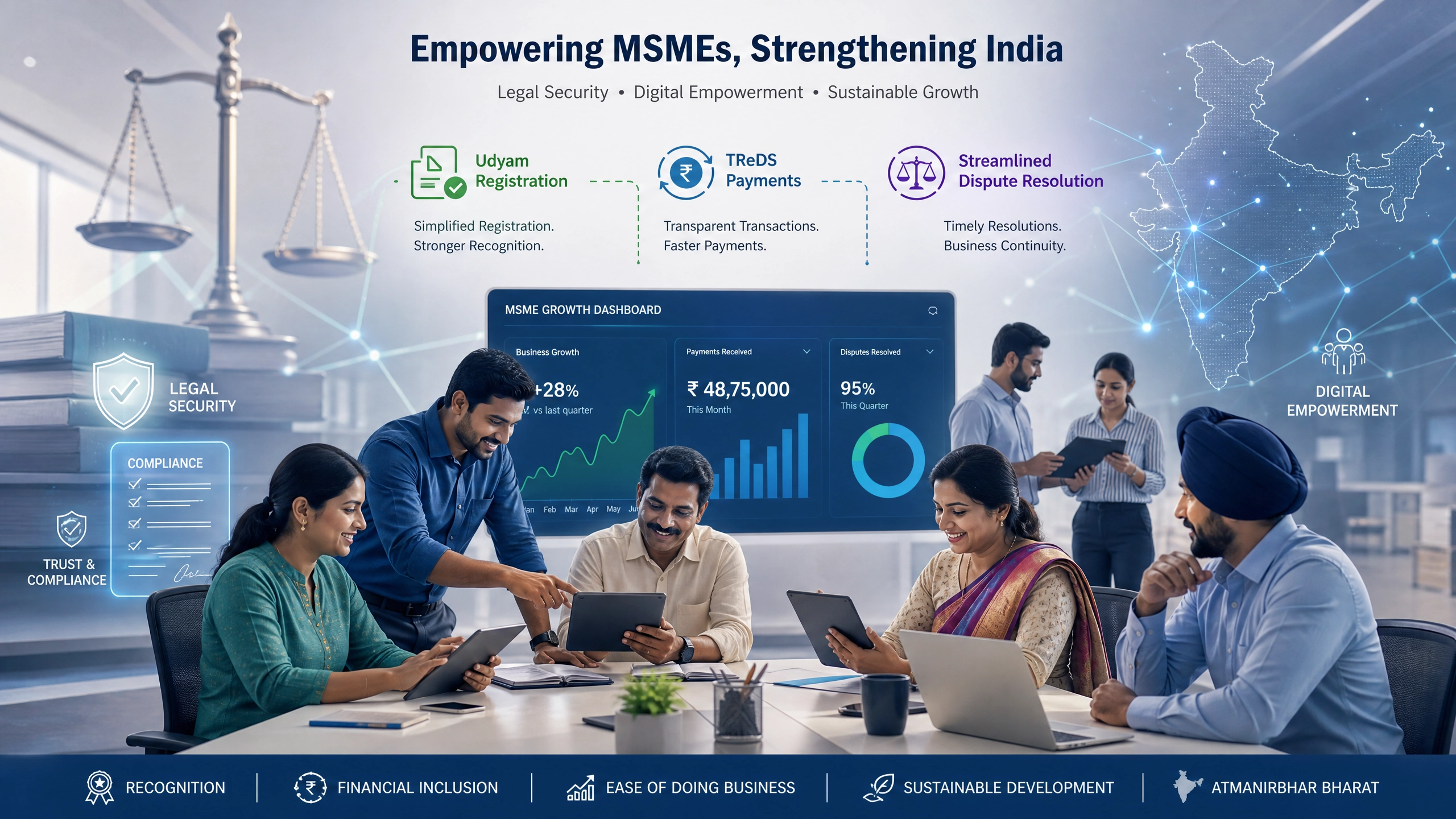
Introduction: The Lifeline of India's Economy Micro, Small, and Medium Enterprises (MSMEs) form the economic backbone of India, contributing significantly to employment generation, manufacturing output, and export revenues. However, despite their vital economic role, small businesses have historically struggled with structural vulnerabilities, chief among them being liquidity crunches caused by delayed payments from corporate buyers and public sector entities. When small businesses face locked-up capital, their operational viability is severely compromised, triggering cascading effects on supply chain resilience. To resolve these systemic challenges, Parliament passed the Micro, Small and Medium Enterprises Development (Amendment) Bill 2026, following approvals in the Rajya Sabha on August 3, 2026, and the Lok Sabha on August 7, 2026. As the legislation awaits the final assent of the President of India, it introduces robust legal instruments designed to enforce financial discipline, accelerate dispute adjudication, and modernize regulatory compliance. This legislative reform transforms the MSMED Act of 2006 to align seamlessly with India's digital economy and contemporary commercial realities. Statutory Permanence and Modernized Classification A foundational pillar of the 2026 Amendment is the formal statutory backing given to the digital registration ecosystem. The legislation provides legal permanence to the Udyam Registration Portal, establishing it as the official, digital, free, and voluntary registration platform for enterprises. While registration remains strictly voluntary, its formal statutory recognition ensures that registered entities enjoy assured access to institutional credit, government procurement preferences, and priority sector lending without administrative delays. Furthermore, the amendment incorporates dynamic statutory parameters for enterprise classification based on investment in plant and machinery and annual turnover. This dual-criterion framework prevents anomalies where growing businesses prematurely lose statutory benefits, ensuring a smoother transitional growth trajectory. By grounding enterprise classification in objective financial metrics, the law provides regulatory certainty for entrepreneurs and investors alike. Reforming Dispute Resolution: Speed, Technology, and Fairness One of the most transformative dimensions of the 2026 Amendment lies in its overhaul of the dispute resolution architecture governing delayed payments. Under the previous legal framework, micro and small enterprises (MSEs) often found themselves entangled in protracted litigation before Micro and Small Enterprises Facilitation Councils (MSEFCs) and civil courts, where legal costs frequently outweighed disputed sums. The new legislation introduces Online Dispute Resolution (ODR) as a formal statutory mechanism, ensuring that disputes are resolved in a timely, cost-effective, and technology-driven manner . To eliminate bureaucratic inertia, the amendment institutes strict statutory timelines across every stage of dispute adjudication: Stage of Dispute Resolution Statutory Timeline Legal Objective Mediation Phase Within 90 days from first appearance date Encourage amicable settlements via MSEFCs or mediation service providers Arbitration Referral Within 30 days from mediation termination Prevent procedural stagnation and transition unresolved disputes swiftly Arbitral Award Delivery Within 90 days from completion of pleadings Ensure rapid finality by facilitation councils or ADR institutions These binding timelines dismantle historical bottlenecks in commercial dispute resolution, ensuring small suppliers are not starved of capital during prolonged legal battles. Safeguards and Enforcement: Interim Relief and Revenue Recovery Recognizing that obtaining a favorable award is only half the battle, the 2026 Amendment introduces formidable enforcement safeguards to compel compliance by defaulting buyers. A critical protective measure is introduced for judicial challenges: if a buyer files an application to set aside a decree, arbitral award, or order, and that application remains pending for more than six months, the buyer is mandated to deposit at least 50 percent of the awarded amount to the micro and small enterprise supplier. This legal mandate curtails frivolous litigation and dilatory tactics often employed by deep-pocketed corporate buyers to delay payouts. Moreover, the amendment revolutionizes execution proceedings. Any mediated settlement agreement or arbitral award rendered by a Facilitation Council, mediation service provider, or ADR institution under Section 18 can now be recovered directly as an "arrear of land revenue" through the District Collector, Deputy Commissioner, or notified authority within the buyer's asset jurisdiction. Leveraging state revenue machinery for commercial recovery elevates the statutory weight of MSME awards, transforming arbitral decrees into high-priority debt instruments. Institutional Accountability: Mainstreaming TReDS for Public Enterprises Liquidity bottlenecks are frequently exacerbated by delayed invoice processing within large institutions. To address this at the institutional level, the 2026 Amendment mandates that all Central Public Sector Enterprises (CPSEs) must route the settlement of all procurement invoices through the Trade Receivables Discounting System (TReDS) platform . "By mandating TReDS integration for CPSE procurements, the legislation bridges the working capital gap through transparent, digital invoice discounting, while creating an enabling mechanism for State governments to similarly nudge state public sector enterprises." TReDS allows micro and small suppliers to auction receivables and receive immediate liquidity from financial institutions at competitive market rates, insulating them from payment delays inherent in traditional bureaucratic accounting cycles. Decriminalization and Trust-Based Compliance In alignment with modern regulatory philosophy, the 2026 Amendment replaces archaic punitive measures with graded civil penalties, fostering a business environment anchored in trust rather than fear. Under the revised legal framework, minor technical infractions such as furnishing incorrect registration information or failing to disclose unpaid amounts with interest in annual accounts have been decriminalized. Violation Type First Instance Consequence Subsequent Instances Consequence Incorrect Information Furnished Formal Statutory Warning Graded Civil Penalty Non-Disclosure of Unpaid Amounts Formal Statutory Warning Graded Civil Penalties and Fines By replacing immediate criminal prosecution and harsh fixed fines with a warning-first approach, the law encourages voluntary compliance and reduces compliance anxiety for honest entrepreneurs. Conclusion The MSME Development (Amendment) Bill 2026 represents a watershed moment in Indian commercial jurisprudence. By fusing digital infrastructure with rigorous enforcement mechanisms, the legislation addresses core anxieties of small business owners: delayed payments, cumbersome litigation, and punitive compliance. As this landmark bill transitions into active law, it empowers micro, small, and medium enterprises to operate with renewed confidence, financial security, and legal certainty, driving sustainable economic growth ac

Tags

MSME Development Bill 2026, Delayed Payments, Micro and Small Enterprises, Ease of Doing Business, Online Dispute Resolution, TReDS, Udyam Registration, Commercial Law India

Written by

Aditya Kumar

Aditya Kumar

Corporate law and criminal law

Fourth year law student at Chanakya National law University, Patna

View Profile →