China's Rare Earth Export Controls: The Silent Crisis Reshaping the Global Economy
Technology

China's Rare Earth Export Controls: The Silent Crisis Reshaping the Global Economy

Published on 7/17/2026

Summary

Headlines tend to fixate on wars, inflation, and stock market swings. But another force is quietly reshaping the global economy: China's tightening grip on rare earth exports. These elements are essential to smartphones, electric vehicles, fighter jets, AI chips, wind turbines, and medical equipment — and because China dominates their processing, its export restrictions have alarmed governments and industries worldwide. Some international assessments put trillions of dollars in manufacturing at risk if disruptions deepen. This article examines what's happening, why, and what it could mean for global trade, technology, and geopolitics over the next decade.

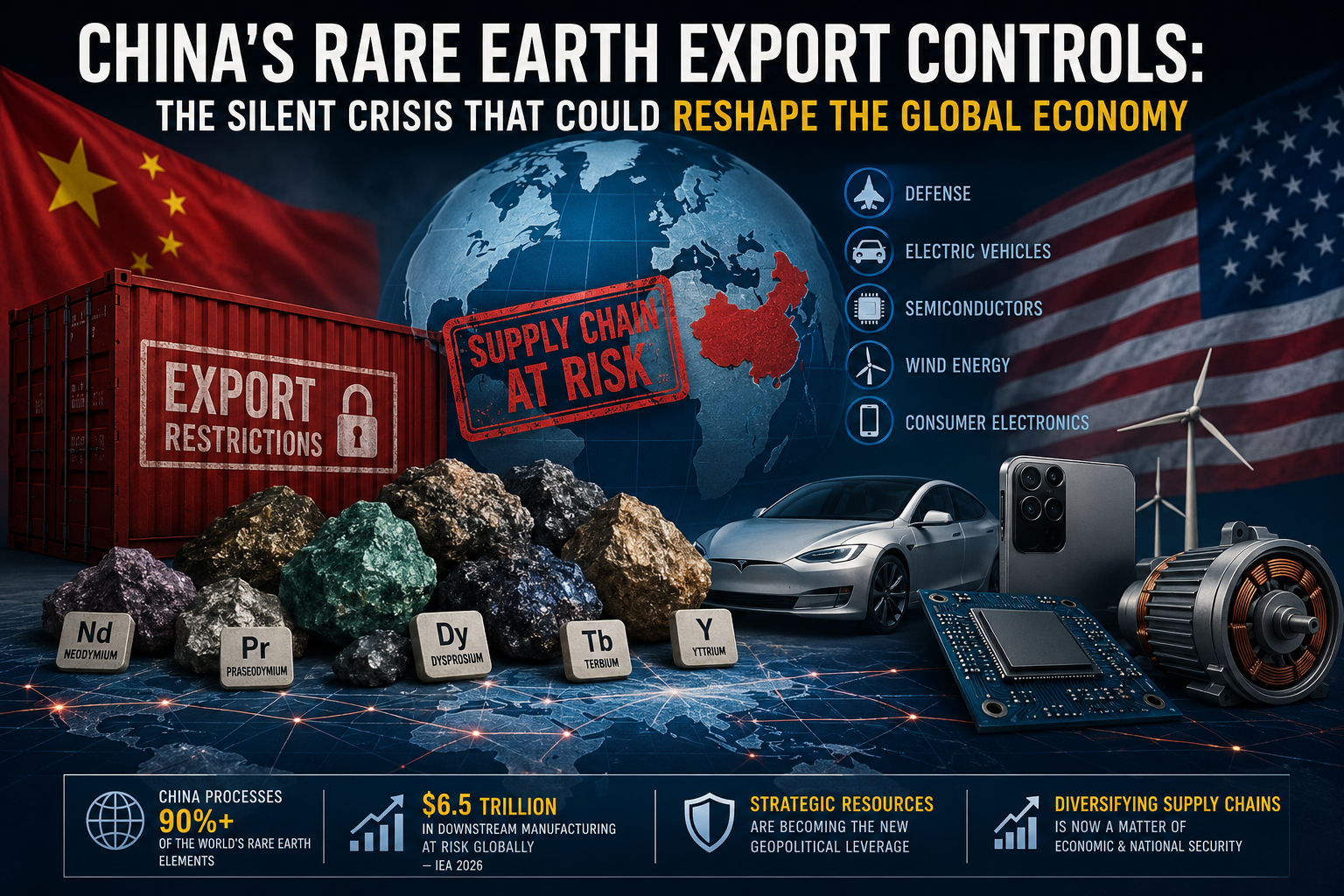
What Is Happening One of the defining economic stories of 2026 isn't a financial crisis or a recession — it's an escalating contest over critical minerals, and rare earth elements sit at its center. China, the world's largest processor and exporter of rare earths, has expanded export controls on several strategically vital materials, now requiring companies to secure government licenses before shipping them abroad. The rollout has been gradual, but governments and businesses are already treating it as one of the most consequential supply chain risks in years. The International Energy Agency estimates that as much as $6.5 trillion in downstream manufacturing outside China could ultimately be exposed to disruption if restrictions tighten further. Rare earths are easy to underestimate because they're used in such small quantities. In practice, they are among the most consequential raw materials in the modern economy, underpinning: Electric vehicles AI hardware and data centers Smartphones and laptops Wind turbines Medical imaging equipment Satellites and fighter aircraft Missile guidance systems Robotics and industrial automation Without them, modern technology manufacturing simply cannot scale. What makes the situation especially fraught is China's dominance not in mining, but in refining. Minerals extracted in Australia, the United States, or across Africa are frequently shipped to China for processing before they're usable — meaning the world's biggest tech, automotive, defense, and renewable energy firms remain structurally dependent on Chinese supply chains, regardless of where the raw ore originates. Why It's Happening To understand this moment, you have to look past mining and into geopolitics. Rare earths have become a strategic resource comparable to oil in the twentieth century, and China recognizes the leverage that comes with controlling them. Competition between China and the United States has intensified across AI, semiconductors, advanced computing, EVs, defense technology, telecommunications, and clean energy — and increasingly, countries are reaching for control over strategic resources as a lever, not just tariffs. China's licensing system appears to serve three overlapping goals. 1. Securing domestic supply. Rare earths are finite. As demand from China's own EV, AI, and defense industries grows, export controls let Beijing prioritize domestic manufacturers while still retaining influence over who gets access abroad. 2. Countering Western tech restrictions. The U.S. and its allies have restricted exports of advanced semiconductor technology and AI chips to China. Beijing's response has been to lean on the resource where its dominance is hardest to match — critical minerals — marking a broader shift from conventional trade disputes toward contests over strategic technology and industrial capacity. 3. Reinforcing China's manufacturing ecosystem. Mining is only the first link in the chain. China also leads in refining, magnet production, battery manufacturing, and electronics assembly. Export controls entrench the value of that integrated ecosystem and make it harder for rivals to build viable alternatives quickly. Why the World Is Concerned The concern isn't simply whether minerals are available — it's concentration risk. When a single country controls most of the world's processing capacity for materials that power modern technology, a disruption there ripples through nearly every major industry at once. Automakers could face production delays. Chipmakers could face shortages. Defense contractors could struggle to source specialized materials. Renewable energy projects could grow more expensive. Consumer electronics could see production costs climb. That's why governments across North America, Europe, Japan, South Korea, and Australia now treat rare earth security as a national strategic priority, not merely a commercial concern. Impact on the Global Economy Manufacturing costs Scarcity pushes prices up. As manufacturers pay more for critical minerals, those costs eventually flow through to consumers — in pricier vehicles, electronics, industrial equipment, and clean energy infrastructure. Inflation Higher input costs feed inflation, complicating an already difficult balancing act for central banks managing growth and price stability. Recent central bank assessments have flagged geopolitical supply disruptions as a distinct inflation risk. Artificial intelligence AI's growth depends on massive computing infrastructure, which depends on advanced semiconductors, which depend on specialized minerals. A disruption anywhere in that chain raises costs and could slow data center and AI expansion plans. Electric vehicles EVs rely heavily on permanent magnets built from rare earth elements. Tighter supply could mean higher costs, slower production, or delayed model launches — with knock-on effects for the broader shift to cleaner transportation. Defense Fighter aircraft, radar systems, precision missiles, submarines, and drones all depend on rare earth components, which is precisely why governments increasingly frame mineral security as a national security issue rather than an industrial one. How Countries Are Responding Governments are moving to reduce reliance on a single supplier, though the response varies by region: The United States has significantly increased funding for domestic mining and refining projects. Australia is expanding critical minerals production. European countries are forging partnerships with resource-rich nations in Africa, South America, and Asia. Japan continues diversifying its supply chains, building on lessons from earlier rare earth disputes. Corporations are redesigning procurement strategies — holding larger inventories and sourcing from multiple countries rather than relying on single suppliers. None of this happens quickly. Mines and refining facilities are expensive, technically complex, and bound by strict environmental regulation, so meaningful diversification will take years, not months. The Broader Lesson This story illustrates a shift in how competitive advantage works. It's no longer determined solely by labor costs or manufacturing efficiency — increasingly, it hinges on control over strategic resources. Globalization is entering a new phase where companies optimize not just for cost, but for resilience. Supply chain diversification, geopolitical risk management, and resource security have moved from operational afterthoughts to boardroom priorities. For managers, entrepreneurs, investors, and policymakers, the takeaway is the same: geopolitical events now directly shape corporate profitability, investment decisions, inflation, and consumer prices. Conclusion China's rare earth export controls are about far more than mining policy. They signal a structural shift in the global economy, where access to critical resources now carries the same strategic weight as access to capital or technology. The world is entering an era where economic competition increasingly turns on supply chains, critical minerals, semiconductors, and AI — not traditional trade alone. Whether these controls evolve toward broader international cooperation or deeper fragmentation will depend on diplomacy and investment in alternative supply chains in the years ahead. For students of business, finance, economics, and international relations, this is one of the defining stories of the decade — a clear illustration that geopolitics, technology, and economics are now inseparable. The countries and companies that build resilient supply chains today are likely to shape the global economy for years to come.

Tags

Global Economy · China · Rare Earth Elements · Supply Chains · Trade Policy · Semiconductors · Electric Vehicles · Artificial Intelligence · Manufacturing · Geopolitics · Critical Minerals

Written by

Keshav Kumar Ray

Keshav Kumar Ray

Finance Buisness

Finance is much more than numbers; it is the story of every economic decision. Being a finance writer for ScholarsView, I examine current financial news and discuss economic concepts behind those events. The idea is to turn such complex notions as inflation, RBI decisions, banking, financial markets, corporate finance and so forth into simple and understandable knowledge. Every article addresses two main questions: What is going on? Why is it going on?

View Profile →